


Most people walk into a jewelry store with one question in mind: "How many carats?" That's the wrong question. Or at least, an incomplete one.
Carat tells you the weight of a stone. It doesn't tell you how large it will appear on the finger. It doesn't tell you whether the cut you've chosen will cast sparkle in every direction or focus it in one spot like a lens. It doesn't tell you whether this particular stone size will be proportionate to the hand of the person who will wear it for decades to come.
This guide starts with another question: what do you want this ring to look like in ten years?
A carat is mass, not size.
One carat weighs 0.2 grams. In the case of diamonds and moissanites, carat is a measure of mass, not diameter. The problem is that most people think of it as size.
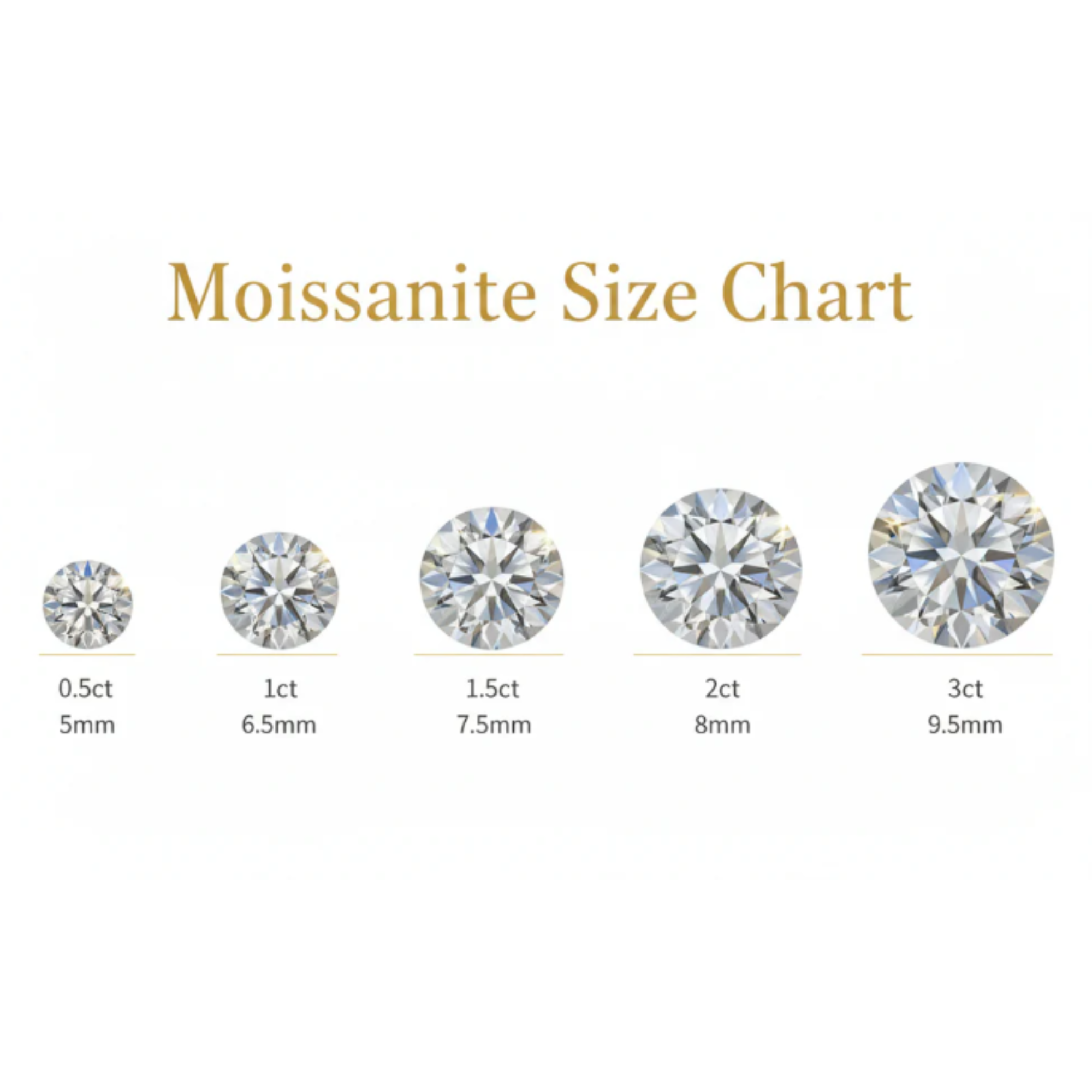
Moissanite is slightly lighter than a diamond for the same volume. A moissanite stone weighing 1 ct diamond equivalent has a diameter of 6.5 mm in a brilliant cut. A stone described as "1 ct moissanite" can mean two different things: either a stone weighing exactly 0.2 g, or a stone with the size of a 1 ct diamond. Reputable stores – including Moissanit.pl – use the designation "ct DEW" (Diamond Equivalent Weight) to clarify what the number refers to. Before buying, it's worth asking directly: what is the stone's diameter in millimeters?
What does each size look like on your finger?
This is a question that catalogs rarely answer directly. Here's a practical breakdown:
0.5 ct (~5.2 mm diameter) An elegant, understated stone. It looks proportionate and refined on narrower hands. It may be subdued on wider hands. A good choice for women who prefer understated jewelry—one that stands out but doesn't dominate the look.
1 ct (~6.5 mm diameter) The classic engagement ring size. Visible on every hand and proportionate on most. This size has been the benchmark for engagement rings in Poland and Western Europe for decades. If you don't have a reason to go up or down, 1 ct in a brilliant or oval cut is a safe and proven choice.
1.5 ct (~7.3 mm diameter) This is where the stone's presence begins. On hands of sizes S–M, it looks intense and striking. On larger hands, it looks natural and proportionate. A good midpoint for those who want the stone to be visible without being ostentatious.
2 ct (~8.2 mm diameter) A large stone. Immediately noticeable. It requires confidence from the wearer—and a wider band to maintain proportions. In 585 gold with the right setting—for example, a halo style or a twisted band—a 2 ct stone looks impressive without being overbearing. In a minimalist setting, a solitaire can be overwhelming for narrower hands.
Above 2 ct Stones 3 ct and larger are choices for those who consciously seek a "statement piece" effect. It's worth trying on or ordering a sample before purchasing – because the difference between how a stone looks in a photo and how it sits on a particular hand can be significant.
Cuts: what are the differences and which one to choose?
Cut isn't just a matter of shape. It determines how the stone reacts to light—where it focuses its brilliance, how large it appears in relation to its mass, and how scratch-resistant it is at the edges.
Brilliant cut (round)
The oldest and most studied jewelry cut, its 58 facets are positioned to maximize light reflection back toward the observer. In moissanite, the brilliant cut emits an intense rainbow flame—spectacular, especially in side lighting.
Who's it for: Anyone who wants a classic look and maximum shine. A safe choice for any occasion and any outfit.
Oval cut
Over the past five years, the oval has become the most popular custom cut in the engagement ring market. The reason is simple: an oval, at the same weight, appears larger than a diamond. The shape, which elongates the stone, also visually elongates the finger. This is a double advantage for narrow or short fingers.
Important: ovals have a phenomenon called "bow-tie" – a dark shadow in the center of the stone, visible from a certain angle. In well-cut stones, this is minimal, but in cheaper ones it can be dominant. When buying, it's worth asking for a video of the stone in motion – the bow-tie is only visible when the stone is rotated.
Pear cut
Asymmetrical, with one pointed tip. When properly positioned in the frame – with the point facing up, towards the nail – it visually elongates the finger more than an oval. The edge of the blade is susceptible to damage if the frame is not protected. In a good frame with a protected tip, it is durable and attractive.
Marquise cut
Spindle-shaped, with two sharp points. One of the cuts with the greatest visual impact relative to its weight: a 1-carat marquise looks like a 1.5-carat brilliant. Well-proportioned for narrow, long fingers. Requires a setting that protects both points.
Emerald cut
A rectangle with slightly chamfered corners and gradual facets – a so-called "step cut," unlike brilliant facets. It doesn't throw off rainbow reflections: it focuses on a deep, calm shine. This is a cut that "shows off" the stone, not shines for it. In moissanite, it requires a stone with very good clarity, because an emerald cut doesn't hide inclusions as effectively as a brilliant.
Who's it for: Those who appreciate elegance without the show. If someone describes their style as "minimalist" or "classic," an emerald cut is worth considering.
Cushion cut
Square or rectangular with rounded corners and deep facets. It produces a warm, intense glow with a high amount of internal reflection. Visually less "sharp" than a brilliant, more "rich." In moissanite, cushion produces a particularly strong fire effect.
Moissanite 1 ct vs 2 ct: The Practical Difference
The question "1ct or 2ct?" comes up most often. The answer depends on three things: budget, hand size, and the personality of the bride.
The price difference between a 1ct and a 2ct moissanite in 585 gold is typically between 1,000 and 2,000 PLN – significantly less than between diamonds of this size. This is one of moissanite's practical advantages: going from 1ct to 2ct doesn't require doubling your budget.
The visual difference is real. 6.5mm versus 8.2mm diameter—that's a 1.7mm difference, which makes a noticeable difference on the finger. If someone were to bring photos of both sizes on the same hand, the difference would be obvious.
The decision is simple: if your hand wears a ring size 17 or larger, 2 ct looks proportionate. If your hand is a size 14-16, 1.5 ct is the sweet spot. Below 14, 1 ct is sufficient.
The setting changes everything
The biggest mistake when choosing moissanite: focusing solely on the stone and treating the setting as secondary.
The setting determines the appearance of the stone on the finger more than its mass. The twisted rail visually lifts the stone and gives it movement. The hidden halo—a small circle of small stones beneath the main stone—visually enlarges the center without changing its size. The bezel setting (a metal frame around the stone) creates a modern, flat effect and provides maximum protection for the edges.
Before deciding on a stone size, check how it looks in the setting you're considering. The same 1ct in a classic solitaire setting and the same 1ct in a halo setting are two completely different rings.
Practical decision table
|
Hand size |
Budget |
Recommendation |
|---|---|---|
|
Little (ages 13–15) |
Everyone |
1 ct, oval or brilliant cut |
|
Middle (ages 15–17) |
Moderate |
1.5 ct, oval or cushion cut |
|
Middle (ages 15–17) |
Higher |
2 ct, oval cut or halo diamond |
|
Larger (ages 17+) |
Everyone |
min. 1.5 ct; 2 ct looks natural |
The last sentence
There's no wrong choice between 1ct and 2ct, between an oval and a brilliant. There's a choice that suits your particular hand, your particular style, and your particular budget.
At Moissanit.pl, you'll find stones in every cut and weight, set in 585 gold and 925 silver, with the option of custom sizes or engravings. Each ring is handmade to order, meaning you can choose exactly what you're looking for, not just what's currently in stock.
FAQ – Frequently Asked Questions
What size moissanite should I choose for an average hand?
For a hand size 15-16, the safest and most common size is a 1ct brilliant or oval cut. The stone is clearly visible, well-proportioned, and doesn't dominate the design. If you're looking for a more prominent stone, a 1.5ct halo setting offers a very similar visual effect to a 2ct solitaire, at a lower price.
What is the difference between an oval cut and a brilliant cut in practice?
A brilliant (round) cut is symmetrical and produces an even sparkle all around. An oval cut, with the same weight, appears larger – the elongated shape visually "stretches" the stone and the finger. Ovals are more popular in engagement rings today than diamonds, especially among those looking for something a little less classic. Choosing between them is a matter of taste, not quality.
What is a "bow-tie" in an oval cut and is it a problem?
A bow tie is a bow-tie-shaped shadow that appears in the center of an oval or pear-shaped stone, visible from a certain angle. In well-cut stones, it is minimal and unnoticeable when worn. In less expensive stones, it can be pronounced. Before purchasing, it's worth asking for a video of the stone in motion – the bow tie is only visible when the stone is rotated.
Does 1 ct moissanite look the same as 1 ct diamond?
Yes, in terms of size – both are approximately 6.5 mm in diameter in a brilliant cut. Moissanite is slightly lighter than a diamond for the same volume, which is why stores use the designation "ct DEW" (Diamond Equivalent Weight). If you see moissanite described as "1 ct" somewhere, make sure you know whether it's the actual weight or the diamond equivalent – Moissanit.pl uses DEW designations for clarity.
Which cut is most resistant to damage?
Brilliant (round) cuts – the lack of sharp edges and corners makes them the most mechanically resistant. Cuts with sharp edges – marquise, pear, princess cuts – require a setting to protect the points, as the sharp edges are susceptible to chipping upon impact. With a good setting, any cut is suitable for everyday wear.
Can I choose my own ring size without measuring my fiancée's finger?
The most common women's ring size in Poland is 15–16. If you're unsure, you can order a size 15 ring and receive a free sizing service upon delivery. At Moissanit.pl, sizing is free and included in the price—no need to worry about making a mistake.
Does an emerald cut match moissanite?
Yes, but it requires a good quality stone. The emerald cut is "transparent" – it doesn't hide inclusions as effectively as a diamond. In moissanite grades D-F for color and VVS clarity, the emerald cut looks elegant and serene. If you're looking for intense sparkle and rainbow reflections, choose a brilliant or cushion cut. If you prefer a deep, serene shine, the emerald cut is worth considering.
Does a bigger stone always look better?
No. A stone disproportionately large in the hand can look awkward and be uncomfortable to wear. A 3-carat moissanite on a size 13 hand will dominate and make everyday life difficult. The stone's proportion to the hand is more important than its weight – so it's worth trying on or asking for photos of a specific model on a hand similar to your fiancé's size.
Źródła