


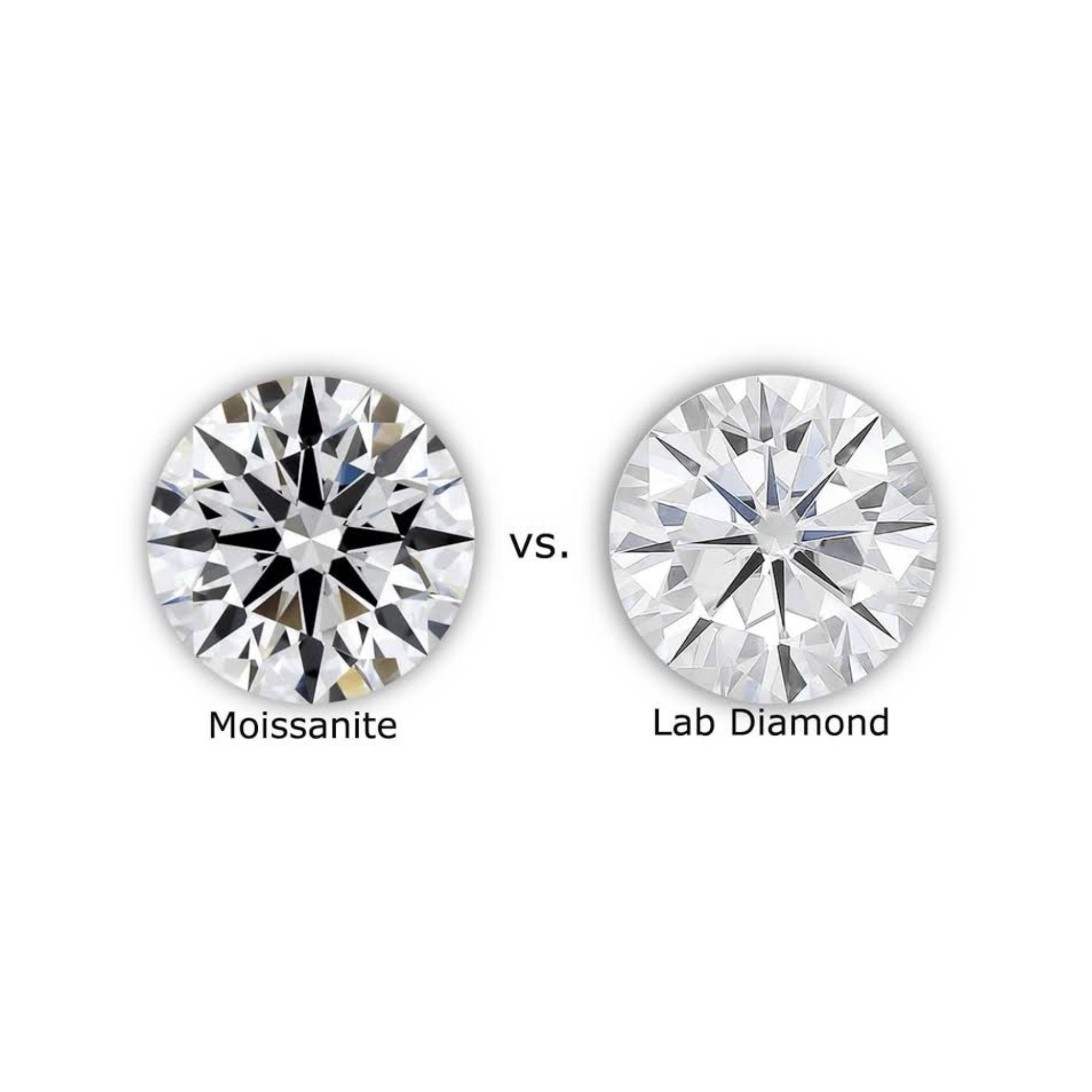
You've bought the box. You've already planned dinner. There's one question left, one that most people leave until the last minute: what should be inside?
Over the past three years, the question of "moissanite vs. lab-grown diamond" has ceased to be a curiosity for the initiated and has become a real dilemma for couples who don't want to overpay for a symbol—but also don't want to compromise on appearance. Both options are vying for the same spot: an engagement ring that looks like diamonds worth tens of thousands of zlotys, but costs many times less.
It's not the same choice. There are important differences – in price, in how they look in candlelight, in what the seller will write on the certificate. Here's what you really need to know before you decide.
What exactly are these stones?
Moissanite is silicon carbide. Discovered in 1893 by Henri Moissan in a meteorite that landed in Arizona – hence the name and the myth of the "stone from space" that jewelers like to invoke. Natural moissanite is practically nonexistent in jewelry quantities. What goes into rings today is grown in laboratories: precisely, under controlled conditions, with repeatable results.
A lab-grown diamond is something different. It's a diamond—the same element, the same arrangement of carbon atoms, the same crystallographic lattice as a stone mined from the earth. It differs only in its origin. The Gemological Institute of America certifies lab-grown diamonds identically to natural ones, assessing color, clarity, cut, and weight using the same scale. No gemologist can distinguish a lab-grown diamond from a natural one with the naked eye. Equipment detects the difference at the level of trace elements of growth—but that's a tool for laboratories, not jewelry stores.
Appearance: Can you really see the difference?
Under most conditions, no. Both stones are colorless, hard, and in standard cuts—brilliant, oval, pear—look very similar.
There's one exception. Moissanite has a higher dispersion coefficient than diamond: 0.104 versus 0.044. What does this mean in practice? In strong side light—in a restaurant with wall sconces, in the summer sun, under a reading lamp—moissanite emits more rainbow reflections. Jewelers call this the "disco effect." Some love it, others think it's a bit too loud.
A lab-grown diamond behaves like a natural diamond: a deep, white brilliance without excessive rainbow highlights. If you're looking for a stone that looks like a traditional diamond, a lab-grown diamond is closer to the original.
If someone wants maximum brilliance, regardless of what it produces, moissanite makes a greater impression here.
Price: How much will you really pay?
This is the most important difference and the only one that cannot be ignored.
Moissanit 1 ct w oprawie złota 585 kosztuje w Polsce od 1 900 do 3 000 zł, zależnie od szlifu i projektu. Diament laboratoryjny tej samej masy i zbliżonej jakości – od 4 000 do 8 000 zł, a premium szlify certyfikowane przez GIA sięgają wyżej.
Przy kamieniach 2 ct różnica jest jeszcze bardziej widoczna. Moissanit 2 ct w złocie: 3 000–4 500 zł. Diament laboratoryjny 2 ct: 8 000–15 000 zł. Ten sam rozmiar, zbliżony wygląd, trzykrotnie wyższa cena.
Skąd ta różnica, skoro oba kamienie są syntetyczne? Diament laboratoryjny zachował prestiżową etykietę. Rynek nadal wycenia słowo „diament" – nawet gdy pochodzi z reaktora CVD, a nie z kopalni w RPA. Moissanit tej etykiety nie ma i prawdopodobnie nigdy nie będzie miał. To czyni go tańszym.
Twardość i trwałość
Moissanit w skali Mohsa ma twardość 9,25. Diament – 10. Obydwa są twardsze niż cokolwiek, na co natrafimy w codziennym życiu: kwarc, beton, stal. Oba nadają się na biżuterię noszoną każdego dnia przez dekady bez ryzyka zarysowania.
W praktyce różnica twardości między 9,25 a 10 nie ma znaczenia dla pierścionka zaręczynowego. Byłoby inaczej, gdybyś planował używać go jako narzędzia do szlifowania szkła. Do noszenia na palcu – obydwa są niezniszczalne.
Certyfikat i wartość odsprzedaży
Diament laboratoryjny jest certyfikowany przez GIA lub IGI z pełną kartą oceny: masa, barwa, czystość, szlif. Certyfikat jest fizycznym dokumentem, który można pokazać, który ma numer laserowo wygrawerowany na koronie kamienia, który da się sprawdzić w bazie danych.
Moissanit ma certyfikat producenta – zazwyczaj Charles & Colvard lub podobny – potwierdzający, że kamień jest tym, za co się podaje. To uczciwy certyfikat, ale nie jest tym samym co certyfikat GIA.
Co do wartości odsprzedaży: żaden z tych kamieni nie jest inwestycją. Wartość odsprzedaży diamentów laboratoryjnych spadła gwałtownie w ostatnich latach – wzrost produkcji obniżył ceny o kilkadziesiąt procent od 2020 roku. Moissanit nigdy nie był postrzegany jako inwestycja. Jeśli kupujesz pierścionek zaręczynowy z myślą o jego wartości za dwadzieścia lat, żaden z tych wyborów nie jest właściwy.
Kwestia etyczna
Obydwa kamienie nie wymagają wydobycia. To oznacza: brak szkód środowiskowych związanych z kopalnictwem, brak ryzyka finansowania konfliktów zbrojnych, brak pytań o warunki pracy w afrykańskich kopalniach. W tym sensie są równoważne – i obydwa są lepszym wyborem niż naturalny diament dla kogoś, kto bierze etykę zakupową poważnie.
Który wybrać? Dwa scenariusze
Wybierz moissanit, jeśli: Zależy ci na jak największym kamieniu w jak najlepszej oprawie, w rozsądnym budżecie. Albo jeśli naprawdę lubisz intensywny tęczowy blask. Albo jeśli para ma inne priorytety finansowe – wkład własny na mieszkanie, ślub, podróż – i pierścionek zaręczynowy nie jest miejscem, w którym chcecie wydawać maksimum.
Pierścionek z moissanitem wygląda pięknie. Nie jest „prawie diamentem" ani „zamiennikiem". Jest osobnym kamieniem z własnym charakterem, który w odpowiednim świetle robi wrażenie, jakiego diament zrobić nie potrafi.
Wybierz diament laboratoryjny, jeśli: Słowo „diament" ma dla was znaczenie – symboliczne lub towarzyskie. Jeśli dla przyszłej narzeczonej ważne jest, żeby mogła powiedzieć „to diament" i żeby certyfikat GIA był prawdziwy. Jeśli bardziej klasyczny, spokojniejszy blask kamienia jest bliższy jej gustowi. Jeśli budżet na to pozwala i nie chcecie kompromisów w tym jednym miejscu.
Podsumowanie w jednym zdaniu
Moissanit daje więcej kamienia za mniej pieniędzy. Diament laboratoryjny daje certyfikowanego diamentu w etycznej cenie. Oba są uczciwe – pytanie tylko, co dla was naprawdę się liczy.
W ofercie Moissanit.pl znajdziesz oba typy kamieni w autorskich oprawach złota 585, z dożywotnią gwarancją na kamień i bezpłatną korektą rozmiaru. Możesz też zamówić projekt na indywidualne życzenie – jeśli wiesz, czego szukasz, ale nie możesz tego znaleźć gotowego.
FAQ - Frequently asked questions
Does moissanite look like a real diamond?
In most situations, yes. The difference is visible primarily in strong side light, where moissanite emits more rainbow reflections than diamond. To the average observer without jewelry knowledge, the two stones appear indistinguishable.
Is a lab diamond a "real" diamond?
Yes. A lab-grown diamond has the same chemical composition and crystal structure as a natural diamond. GIA certifies it according to the same criteria: mass, color, clarity, and cut. The only difference is its location—a CVD reactor instead of deep underground.
Is moissanite durable? Will it scratch?
Moissanite has a hardness of 9.25 on the Mohs scale—harder than sapphires, rubies, and anything else you encounter in everyday life. It takes a diamond to scratch moissanite. In practice, a moissanite ring can be worn daily for decades without fear of damaging the stone.
Will a jeweler recognize that it is moissanite and not a diamond?
An experienced jeweler with a diamond tester can verify this – electrical and thermal tests produce different results for diamond and moissanite. To the naked eye, even under a magnifying glass, the difference isn't obvious. If someone asks a jeweler, "Is this a diamond?" without context, the answer depends on the tools they use.
Which stone holds its value better?
Neither is an investment. The resale value of lab-grown diamonds has fallen sharply since 2020 as production has increased. Moissanite has never been viewed as an asset. An engagement ring is purchased as a symbol, not as an investment – and from that perspective, both choices are fair.
Can I order a moissanite ring in gold?
Yes. At Moissanit.pl, all settings are available in 585 gold (white, yellow, and rose) and 925 silver. It's also possible to order a custom design with your choice of stone and metal.
How long does it take to process an order?
Moissanite rings are typically processed within a few business days. The "Ready to Propose 24h" option allows you to receive your chosen model within 24 hours. Rings with lab-grown diamonds require a longer delivery time – up to 21 business days – due to stone certification.
Does moissanite change color over time?
Yeah. High-quality moissanite – color grades D–F – remains colorless throughout the stone's life. Cheaper, lower-grade moissanites may have a slight yellowish or greenish tint, especially visible in natural light. Therefore, it's best to buy from reputable sellers with a certified stone.
Źródła
- https://www.brilliantearth.com/gemstones/buying-guide/moissanite/
- https://www.gemsociety.org/article/moissanite-vs-diamond/
- https://www.igi.org/reports/lab-grown-diamond-report/
- https://www.gia.edu/gem-lab-service/laboratory-grown-diamond-grading-report-service
- https://rapaport.com/news/gia-clarifies-new-guidelines-for-lab-grown-diamond-certificates/